
Farewell Portainer, Hello Dockhand
I’ve mentioned Portainer in a number of blogs, but I don’t think I’ve written one just about Portainer. This isn’t that blog; it’s about why I’m leaving Portainer and now using Dockhand instead.
I can’t even remember when I started using Portainer, but my first blog mentioning it was in early 2018, so that’s coming up on 8 years. It became my default way to manage Docker containers, and probably meant that I didn’t learn enough of the default skills for managing things on the command line. Stacks replaced docker-compose and everything worked remarkably well, almost too well. I always felt lured into a false sense of security, and I never updated any containers without taking a snapshot of the virtual machine I run everything on.
I was always pretty happy with Portainer, but back in September they announced that version 3.0 was coming with a focus on Kubernetes and not Docker. Fairly quickly they clarified that that meant ‘first, and not only‘, but it still suggests a direction of travel somewhat different to the one I’ve been on. Should I be looking at Kubernetes more than Docker? Who knows, but I do know I run some pretty critical services on my Docker VM, and I would be lost without it.
The main one is Bitwarden, which I switched to using at the beginning of 2020. I used 1Password for some years before that, but it was always a little problematic cross-platform, and the subscription model kept changing, and costs kept rising. Bitwarden offered an open-source, self-hosted solution, and I haven’t looked back. I use it daily on all my devices, and it’s pretty much the first thing I install on any device build.
I’ve been running Calibre-web for about the same amount of time; in fact, the first blog about it was 4 days before the Bitwarden one! It’s become even more useful recently after I jailbroke a few of the household Kindles and started using KOReader to manage my library instead of the default Amazon software. Amazon has made it increasingly difficult to send things from Calibre-web, but now I can connect directly from KOReader and transfer books seamlessly. Never has a domain name been truer — KOReader does indeed Rock!
I’ve also been running Teslamate since I discovered it at the beginning of 2022 — there’s a theme here of me finding new solutions to problems over the Christmas holiday, isn’t there? I haven’t blogged specifically about Teslamate, but I did mention it and included a screenshot at the end of my Epic Road Trip blog in 2024. My only regret with Teslamate is that I didn’t discover it when I first got Lexee in June 2021. My Teslamate history starts seven months later and after 4435 miles of untracked driving. We’re now at 39,506, so not too bad.
Anyway, I’ve drifted into what I mainly use Docker for, and not really Portainer or Dockhand, so back on track. I think I stumbled upon Dockhand in a YouTube video when I wasn’t really looking to replace Portainer, but I’m so glad I did. It does everything Portainer did, and a lot more, which makes keeping everything up to date and secure much easier. It’s also very Docker-focused, just like me. Their license model is very reminiscent of Portainer, although you don’t need to apply for a license for homelab use. Portainer allowed up to 3 environments (Dockhand is unlimited), but since I’m only using one at present, that was never an issue. Both were free for my use case, which is always a bonus for software that’s commercially supported and used in small and large enterprises alike.
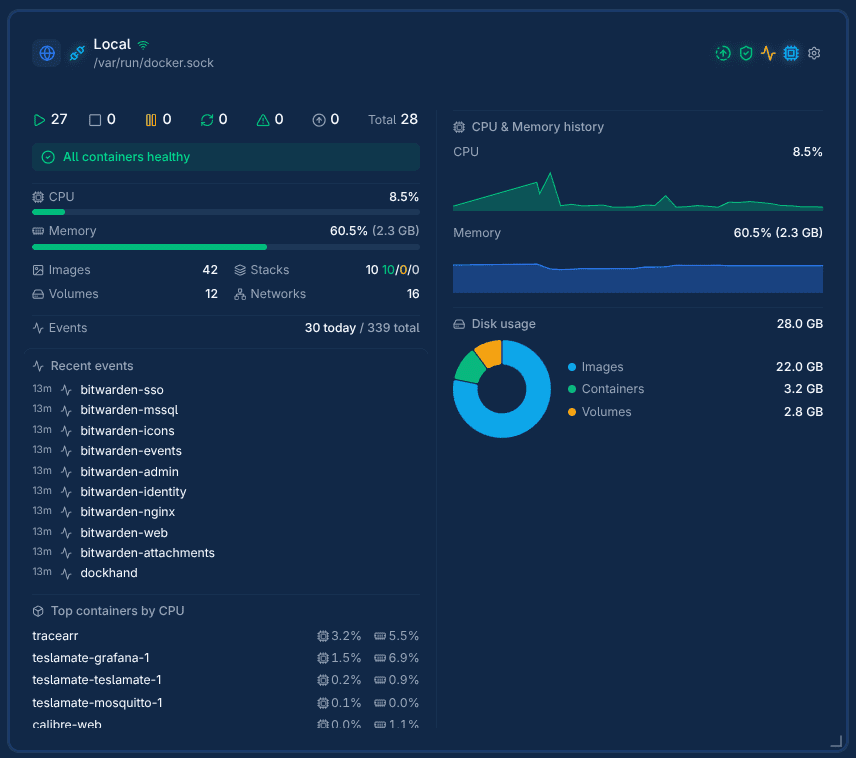
The Dockhand interface also provides much more detail about what’s happening across the environment, another tool I’m happy to have discovered.
I’ve also not mentioned Uptime Kuma or Tracearr. More blogging material to draft right there, but it really reinforces how important my Docker VM is, and why having the right tools to manage it matters. I don’t think I’d even realised how important it was until I started writing this. I’d better go and back things up….
Recent Comments