
I’m pretty sure nobody ever expected to read that blog title, or see PHP become headline news a few weeks ago?
I suspect most people have never even heard of PHP, and why would you, unless you’re managing internet services? Even I was surprised when people started quoting figures that almost 70% of the internet runs on some form of PHP.
I’m pretty sure when Rasmus Lerdorf wrote a handful of C scripts back in 1994 to count visitors to his CV, he never imagined that either. They were released in 1995 as Personal Home Page Tools, with PHP 3 arriving in 1998 with the recursive name it still carries today. PHP 5 brought proper objects in 2004, PHP 6 never shipped, and PHP 7 made everything twice as fast in 2015. PHP 8 added a just-in-time compiler in 2020, and today we’re on 8.5. Thirty-plus years on, it still quietly runs much of the internet, including this WordPress blog and other services I host from my micro-data centre at home.
I last blogged about PHP here when I had a mix of versions from 7.3 to 8.3, the latest at the time, and I blogged about it 5 years before that, here, when I upgraded to 7.2!
Given both blogs have the same PHP timeline, it would be rude not to include the latest one here:
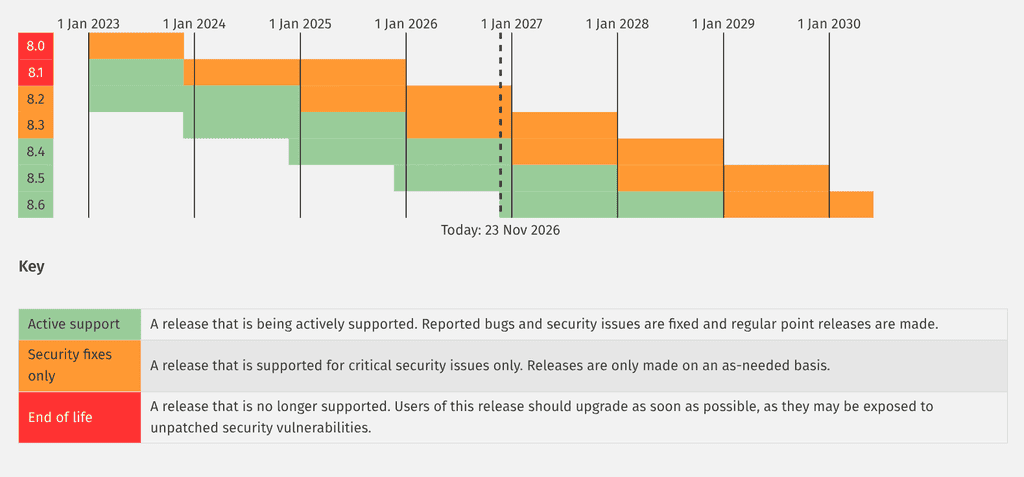
As you can see, the 7.x line is gone, and 8.0 and 8.1 are now EOL. 8.2 and 8.3 are only receiving security fixes, although that’s very much relevant in terms of the story which triggered another PHP blog. But before we get into that, let’s throw in a table of what I am running, just for good measure. I’ve included what I last reported back in April 2026, when I published my last TrueNAS update blog here.
| April 2026 | Now | |
| LimeSurvey | 8.4 | 8.4 |
| MediaWiki | 8.4 | 8.4 |
| Nextcloud | 8.4 | 8.5 |
| Pi-hole | 8.3 | 8.3 |
| WordPress (live) | 8.4 | 8.6 |
| WordPress (test) | 7.3 | 8.6 |
APE Services PHP Versions – April – November 2026
Pretty good, really, although most of the patch.dot versions were lagging back in April, and they’re now brought up to date. I managed to resolve the LimeSurvey issue, which was running 7.4 in the 2025 blog, and while the test WordPress environment was running 7.3 (I’d stopped making it available externally), it’s since been updated to 8.6 — from one extreme to another! I’m not sure why Pi-hole is on the list, since it’s just running the default version from Ubuntu 24.04 LTS, but otherwise everything is in the green. It’s the first time ever, but hopefully something I’ll maintain, given how important all this stuff became on 21 October 2026. You know something is important when it’s the first story on the BBC News and the National Cyber Security Centre (NCSC) webpages.
It certainly wasn’t the news I wanted to hear, as I’d been burying my head in the sand a little about TrueNAS Core’s future, which was still running on the now-EOL FreeBSD 13.5. The package repository is gone, so I couldn’t update any of my services and needed a longer-term solution, which came in the form of FreeCORE. I won’t go into that again, as I blogged about it here, but a few days later I was running FreeBSD 15.1 and had all my PHP versions patched.
I looked into migrating everything from 8.3/4 up to 8.6, but it’s still a little too early for that. WordPress tends to stay ahead of the curve with this stuff, but Nextcloud wasn’t happy (though I did bump it up to 8.5), and LimeSurvey didn’t seem to like 8.5! I’ll certainly keep a closer eye on things in the future, though, and won’t drop anything outside the security patching windows.
Anyway, this is starting to sound like one of my annual ‘state of the server’ blogs, and given we’re not too far from the end of the year, I might be doing one of those again very soon (sorry, Chris) [Jinx]
Recent Comments